
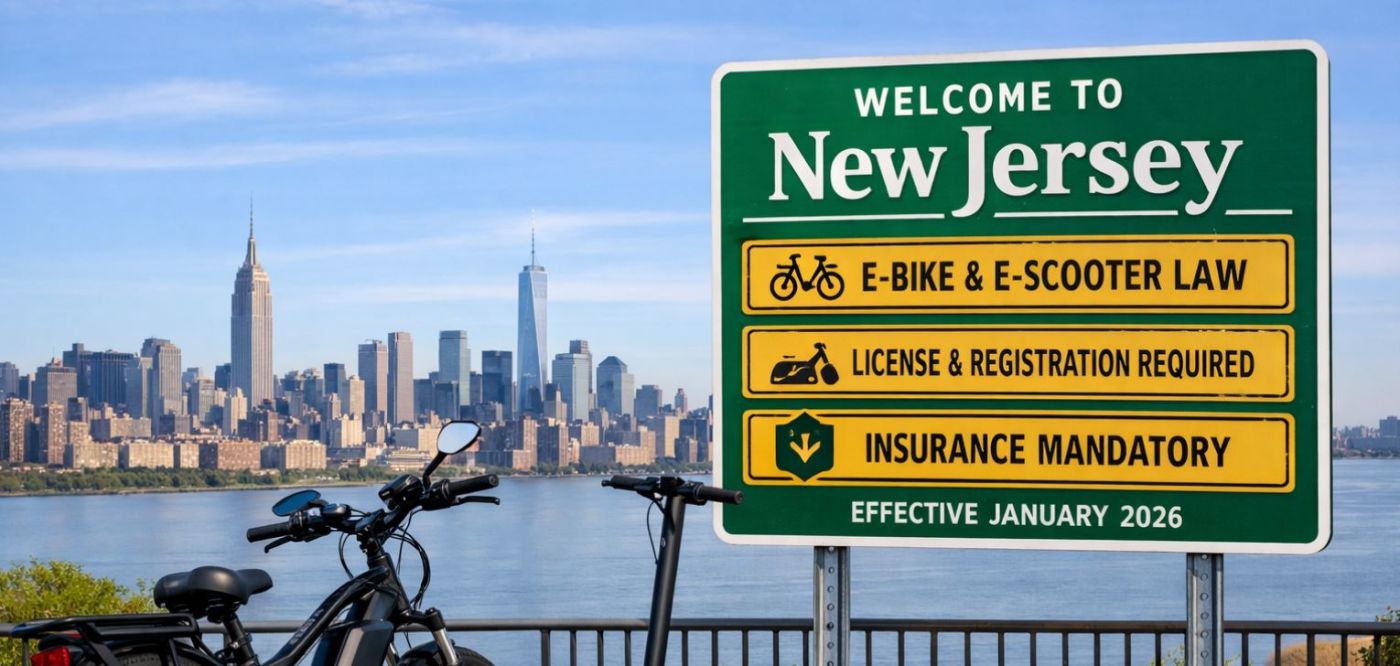
Thinking of riding your e-bike or e-scooter in New Jersey? What New Yorkers should know about NJ’s new licensing, registration, and insurance rules
Mandatory Licensing & Age Limits: You must now be at least 15 years old to operate an e-bike in NJ. Riders aged 15 and 16 must obtain a specialized motorized bicycle license (requiring a permit and test). Riders 17 and older may use a standard Basic Driver’s License.
Registration & Insurance: All e-bikes used on public roads must be registered with the NJ Motor Vehicle Commission (NJMVC) and carry liability insurance.
Compliance Window: While the law is technically in effect, riders have a six-month grace period (until July 19, 2026) to come into compliance with the registration and licensing paperwork while the NJMVC finalizes its new systems.While The Eskesen Law Firm is a New York Law Firm, some of our audience might occasionally head across the Hudson, down the Shore, or over to Jersey City or Hoboken. Due to recent changes, if you do so with an e-bike or a scooter, be aware that New Jersey just changed the landscape in a meaningful way.
As of January 19, 2026, New Jersey enacted a new e-bike safety law (S4834/A6235) that reclassifies many e-bikes as “motorized bicycles” and requires licensing, registration, and liability insurance to use them on public roadways.
This post is written for a New York audience with a “travel checklist” mindset: what changes when you cross into NJ, and the new limits you need to know.
What New Jersey changed (signed January 19, 2026)
New Jersey’s Governor signed S4834/A6235 on January 19, 2026, describing it as among the nation’s toughest e-bike safety packages. The law effectively ends the "bicycle-style" treatment for most e-bikes, moving them into the motor-vehicle framework.
The core practical impact for riders
Mandatory Licensing & Age Limits: You must now be at least 15 years old to operate an e-bike in NJ. Riders aged 15 and 16 must obtain a specialized motorized bicycle license (requiring a permit and test). Riders 17 and older may use a standard Basic Driver’s License.
Registration & Insurance: All e-bikes used on public roads must be registered with the NJ Motor Vehicle Commission (NJMVC) and carry liability insurance. At the Eskesen Law Firm, we always suggest that people protect themselves by purchasing more than the State minimum in coverage. As of the date of this writing, policies for such insurance can be had for less than $100 per year.
Compliance Window: While the law is technically in effect, riders have a six-month grace period (until July 19, 2026) to come into compliance with the registration and licensing paperwork while the NJMVC finalizes its new systems.
Does this apply to e-scooters too?
The Governor’s announcement and the bill summary focus on electric bicycles (e-bikes).
E-scooters and other devices can be regulated under different statutory buckets and local ordinances. If your travel plan involves a stand-up e-scooter, treat NJ rules as device-specific and locality-sensitive (boardwalks, parks, waterfront paths, and municipal rules can differ even when state law is permissive).
The “NY rider traveling to NJ” checklist
If you are a New Yorker bringing your own device into New Jersey, the compliance question is not theoretical. It is a roadside or post-incident question.
Before you ride in NJ, confirm these basics
What exactly is your device?
In NY, many “legal” e-bikes are treated as bicycles for operating purposes. In NJ post-1/19/26, classification is moving toward a motorized-bicycle model for broader e-bike categories.Do you have an appropriate license?
If NJ requires a motorized-bicycle type credential for your category, you want to know whether (a) your driver’s license satisfies it, or (b) you need a separate NJ credential for that device type (especially relevant for teens and non-drivers).Can you actually register it yet?
Since NJ is the first state to implement registration requirements, it may be impossible to legally ride a e-bike from another state, like NY into NJ. NJ implementation is in progress, and the operational details are still being developed by NJMVC according to NJ bike/ped guidance. We will continue to monitor.Do you have liability coverage if required?
If your e-bike category is treated as “motorized” under NJ’s framework, assume enforcement and post-crash scrutiny will increasingly expect proof of coverage where required.
Practical travel advice while NJ’s rollout is still evolving
If you cannot confidently answer the four questions above, consider not riding your personal e-bike in NJ until NJMVC publishes clear procedures for your device category.
Are similar changes coming in New York?
New York is actively debating micromobility policy, especially in dense urban areas. As of the date of this writing, the following bills are being considered:
NY Senate Bill S2528 (introduced January 21, 2025) proposes liability insurance requirements for bicycles, e-bikes, and electric scooters in cities with a population of one million or more (effectively aimed at NYC).
NY Senate Bill S8573 (2025–2026 session) proposes a DMV registration category and process for “electric personal mobility devices,” including devices such as e-bikes and e-scooters meeting certain speed criteria, and contemplates registration and licensing structures.
While the bills should not be treated as enacted unless and until passed and signed, what they signal is a very real possibility of future changes. Given policy pressure, “today’s rules” could change.
Bottom line for New Yorkers
If you ride an e-bike in New York and occasionally cross into New Jersey, you now have to think like a driver crossing state lines: your device may be treated differently the moment you enter NJ, and the “paperwork” expectations can be materially higher. Moreover, until NJ creates the system to register e-bikes, the details remain unknown. It may be impossible for a NY resident to comply with NJ law if their system does not allow for non-residents to register e-bikes.
Date written: January 22, 2026.
Micromobility laws are changing rapidly across states and municipalities. New York proposals are pending, New Jersey’s implementation details are still developing, and enforcement priorities can shift. Check current guidance before traveling, and stay tuned.